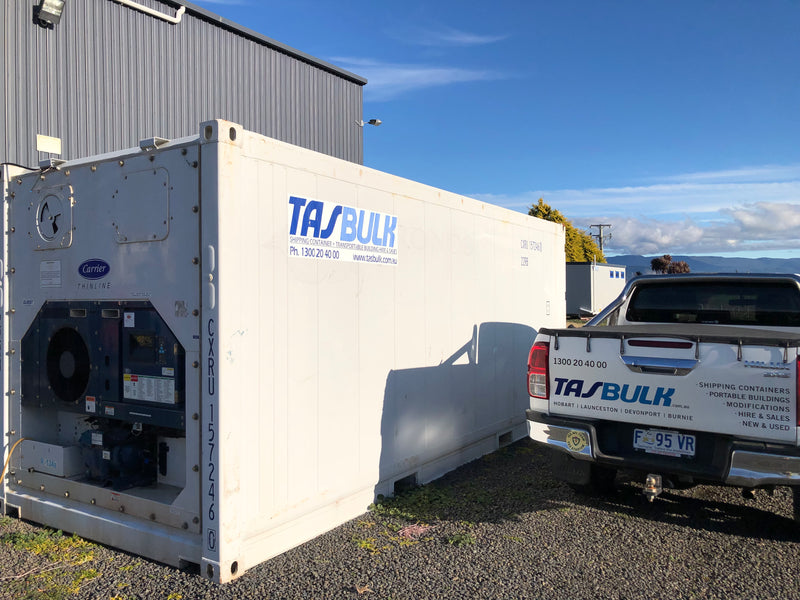
How Do Refrigerated Shipping Containers Work?
Refrigerated shipping containers, often known as reefers, are designed to keep temperature-sensitive goods at a consistent temperature during transport or storage. They are widely used to protect products that require controlled conditions, including food, pharmaceuticals, and agricultural produce.
By combining insulation, controlled airflow, and a built-in refrigeration unit, reefer containers maintain stable internal temperatures even when outside conditions change. This allows businesses to store or transport perishable goods safely and reliably. At Tasbulk, refrigerated containers are supplied to meet a range of cold storage needs across Tasmania, helping businesses maintain product quality and meet strict storage.
What Is a Reefer Container?
A reefer container is a specialised refrigerated shipping container designed to maintain a controlled internal temperature. Unlike standard shipping containers, reefers include insulated walls and an integrated refrigeration unit that keeps goods within a specific temperature range.
They are commonly available in sizes such as 20-foot and 40-foot containers and are used for both transport and on-site cold storage. The insulation helps reduce the impact of external temperatures, while the cooling system regulates the internal environment. Reefer containers are widely used across logistics, food distribution, agriculture, and other industries where products must be stored or transported under controlled conditions.
The Internal Cooling Process and Mechanics
Refrigerated shipping containers use an advanced cooling system designed to maintain consistent internal temperatures for sensitive cargo. The process works by circulating refrigerant through a closed-loop system consisting of a compressor, condenser, expansion valve, and evaporator. Heat is drawn from inside the container and released outside, allowing the unit to keep cargo at the required temperature. Inside the container, powerful fans circulate cold air throughout the container to ensure even airflow around the load. With precise digital temperature controls and continuous air circulation, Tasbulk refrigerated containers provide reliable temperature management for transporting and storing perishable goods.
Refrigeration Unit and Cooling System
The refrigeration unit is responsible for cooling the air inside a reefer container. It operates using three key components: the compressor, condenser, and evaporator. The compressor pressurises the refrigerant and moves it through the system. The condenser releases heat from the refrigerant, allowing it to cool, while the evaporator absorbs heat from the air inside the container. This process lowers the air temperature before the chilled air is circulated back through the container.
Airflow and Temperature Circulation
Proper airflow is essential to ensure temperatures remain consistent throughout the container. Chilled air is pushed through the container floor and circulated around the cargo. As the air moves through the container, it passes around the stored goods before returning to the refrigeration unit to be cooled again. This constant airflow helps minimise temperature variations and ensures the entire container remains within the desired temperature range.
Power Supply and Operation
Refrigerated containers require a reliable power supply to operate their refrigeration systems. When positioned at depots, ports, or storage facilities, they are commonly connected to an external three-phase power outlet, which is the standard electrical supply used for most commercial refrigeration equipment.
Three-phase power delivers electricity through three alternating currents rather than a single line. This provides a more consistent and efficient flow of power, which is essential for running the compressor and other components of the refrigeration unit. The stable power delivery helps maintain consistent cooling performance and reduces strain on the equipment, allowing the container to hold precise temperature settings for extended periods.
During transport, reefer containers can be powered by generator sets attached to trucks, ships, or rail systems. These generators replicate the required power supply, ensuring the refrigeration unit continues operating and the container maintains its temperature while moving between locations.
How Do Reefer Containers Control Temperature?
Reefer containers maintain precise temperature conditions using digital control systems and built-in sensors. Operators can set a specific temperature depending on the product being stored or transported.
Sensors continuously monitor the internal environment and automatically adjust the refrigeration system to maintain the selected temperature. Combined with high-quality insulation, this system helps keep conditions stable and reliable throughout storage or transit.
What Are Reefer Containers Used For?
Refrigerated shipping containers are used across a wide range of industries that rely on temperature-controlled storage. The food industry uses them to store and transport fresh produce, meat, dairy, and frozen products.
They are also commonly used for seafood, pharmaceuticals, and agricultural goods that must remain within strict temperature ranges. Many businesses also use reefer containers as flexible cold storage solutions for events, seasonal demand, or locations where permanent refrigeration is not available.
Benefits of Refrigerated Shipping Containers
Refrigerated shipping containers provide a reliable solution for storing and transporting temperature-sensitive goods. Their controlled cooling systems help protect products from spoilage while maintaining consistent conditions.
They also offer flexibility, functioning as both transport units and on-site cold storage. Because they are durable and portable, reefer containers can be used in a variety of environments including ports, warehouses, construction sites, and remote locations. For many Australian industries, they provide a practical and dependable cold storage option.
Refrigerated Shipping Containers for Reliable Cold Storage
For businesses that require dependable temperature-controlled storage, refrigerated shipping containers offer a practical and flexible solution. They provide consistent cooling performance while allowing goods to be stored safely in a secure and durable environment.
At Tasbulk, we supply refrigerated shipping containers across Tasmania for businesses that need reliable cold storage or transport solutions. Whether you require temporary storage or a long-term refrigerated container, our team can help you find the right option to suit your needs.